
Boys & Girls Club Internship Program

The MUSE Outreach program teamed up with the Boys & Girls Clubs of the Peninsula (BGCP) to create a paid high school internship, during which our brilliant interns design outreach products that illustrate and illuminate MUSE Science concepts: magnetic fields, spectroscopy, technology & innovation, and space weather. Here’s what they created:
1. Angel K — Solar Stickers
The Sun’s Magnetic Field: The sun is a magnet! Our star has a magnetosphere surrounding it, where the field lines have northern (+) and southern (-) polarity. Our Intern’s drawing of the “global magnetic field” is close to what the sun looks like at Solar Minimum, where the field lines look relatively simple. The cartoon also represents how magnetic poles must include a north (+) and a south (-); one cannot exist without the other!


Space Weather: The solar wind is a stream of tiny, charged particles and radiation that flow out from the Sun and travel through space in all directions. NASA’s MUSE mission studies how the Sun’s magnetic activity heats and accelerates the solar wind. This can helps scientists understand how solar eruptions and fast-moving solar wind travel through our solar system.
Spectroscopy: It’s a pun! Helium (He) is “lighter” than Iron (Fe) on the periodic table AND “lighter” also plays on light that creates each spectrum. Both elements glow at specific wavelengths on the Sun. NASA’s MUSE mission studies extreme ultraviolet (EUV) light, specifically emitted by Iron (Fe) ions, to understand solar activity. Our Angel wanted to include Helium because of its historical significance in Heliophysics: astronomers first discovered Helium in the Sun (not Earth!) in 1868.


Technology & Innovation: Angel wanted to explain how NASA’s MUSE satellite advances existing solar physics technology. The IRIS satellite is a NASA Heliophysics mission launched in 2013. IRIS measures spectra from a small portion of its field of view using its single-slit spectrograph. Here, the MUSE spacecraft revels in its ability to process 35x times the amount of data with its multi-slit spectrograph!
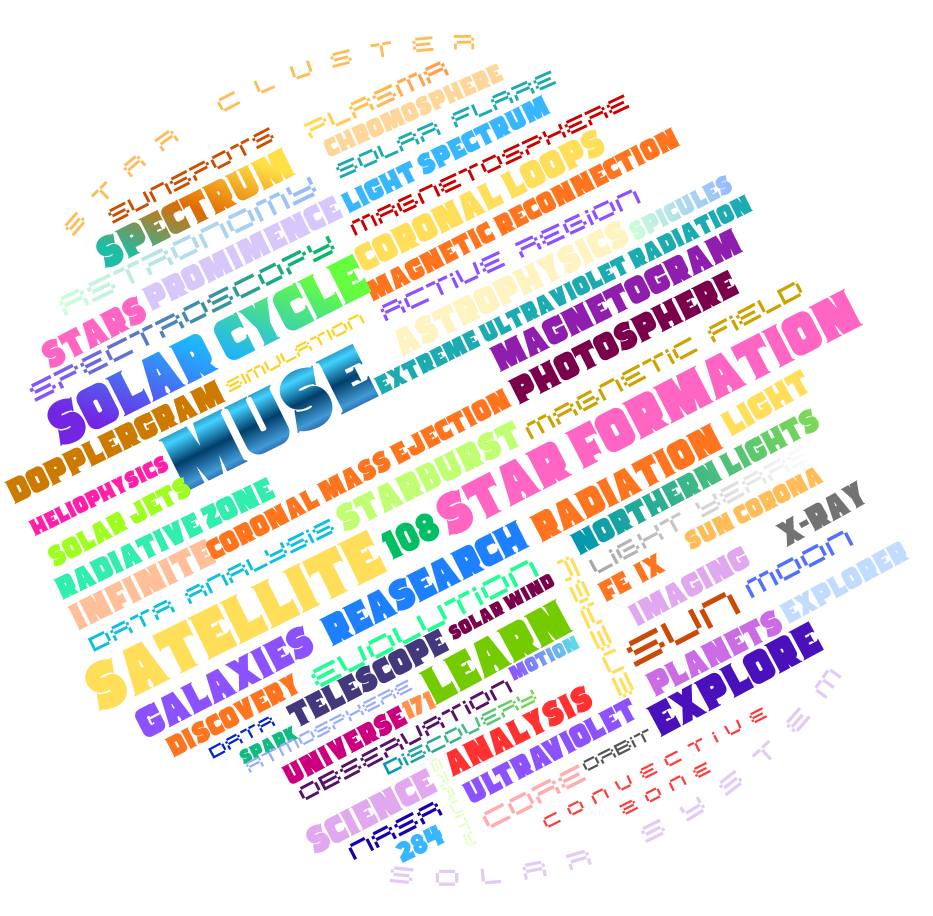
2. Emily D -- MUSE Hoodie
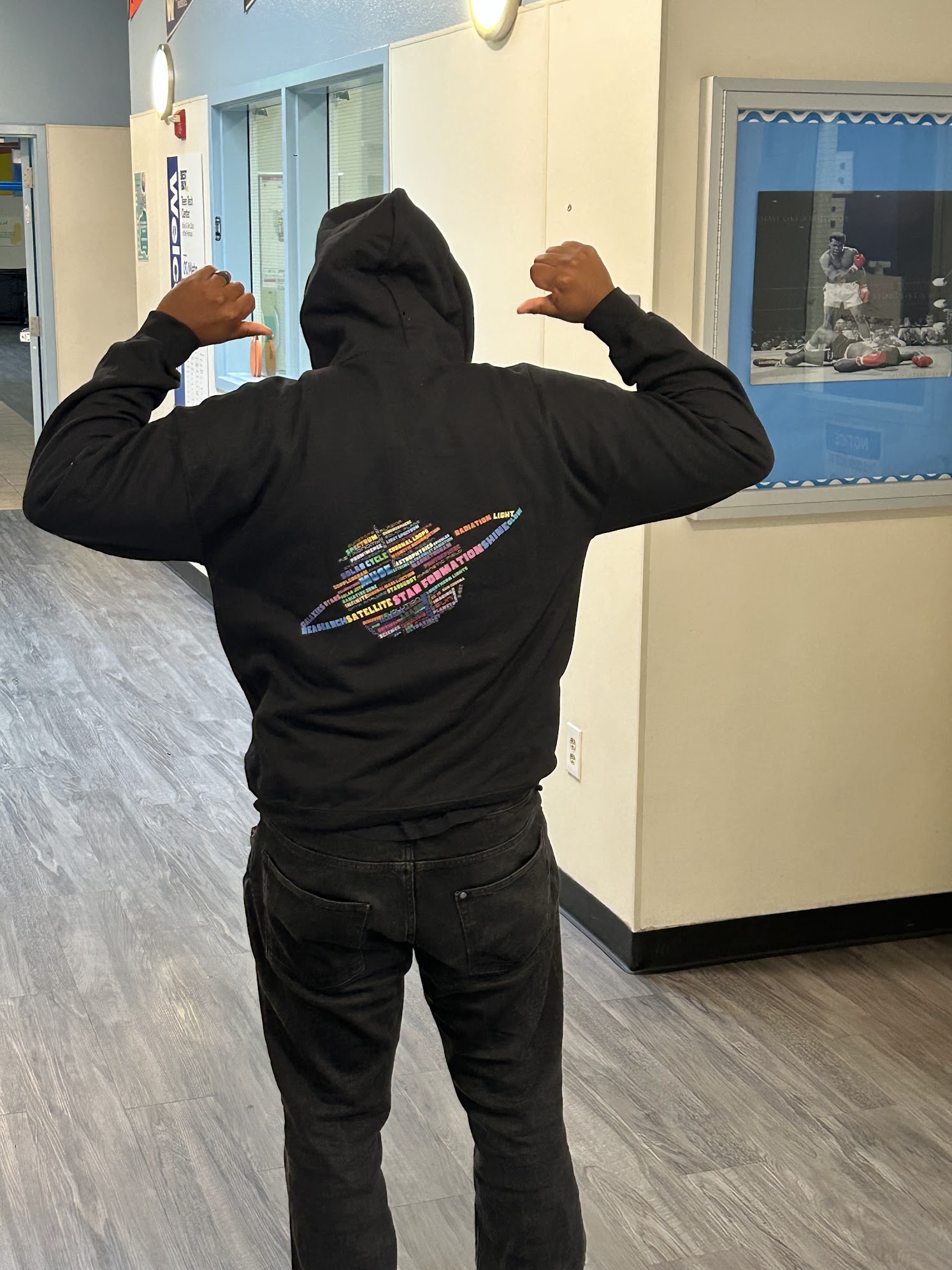
Emili figured that some “wearable envy” would go over well in the neighborhood, so she designed a hoodie featuring the MUSE logo, a space weather visual from NASA’s Science Visualization Studio, and a word cloud of phrases and terms she learned from her MUSE Science mentors. Now, the entire MUSE mission team has the opportunity to sport hoodies and t-shirts with her deisgn!
3. Danny P — Solar Birthdays
Danny was inspired by a picture hanging in the halls of Lockheed Martin Solar and Astrophysics Laboratory that depicted the Sun’s 11-year magnetic cycle. He liked it so much that he wanted to make his own version, using his birthday as a reference date. In Danny’s version, we see the variation of magnetic activity (bright spots) between 2010 and 2020, illustrating examples of solar magnetic maximum and minimum.


4. Shirley G — Space Weather Facts
Shirley organized her newfound knowledge on space weather into a mind map. What is it? How does it affect us? How can the MUSE mission address space weather from the solar side? Here, Shirley communicates the effects that space weather can have on the Earth system.
5. Elvis — Space Weather and MUSE
Elvis used imagery from MUSE science models and NOAA to illustrate the impacts of dynamic solar events that drive space weather. He explains in his double-sided infographic how space weather can impact not only the Earth system and ground-based power systems, but also spacecraft.

